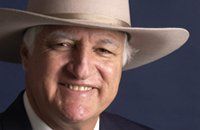
Bob Katter.
Wisdom. Mongrel. Patriot.
Build the nation.
To be owned by Australians.
FEATURED NEWS
By Kahla Kruger
•
December 9, 2025
Second Reading Mr KATTER (Kennedy) (18:02): I wonder whether people in this place ever did a history lesson in their lives. I asked the lady (ALP Member) who was just speaking whether she'd ever planted a tree. In every single environmental meeting I have ever been to— The DEPUTY SPEAKER (Mr Georganas): The member for Kennedy will refer to members by their proper title. Mr KATTER: I don't know what her proper title is. The DEPUTY SPEAKER: It is the member for Macquarie . Mr KATTER: The member for Macquarie—I simply asked her if she'd ever planted a tree. Could I ask you again? Have you ever planted a tree? Ms Templeman: I've planted dozens of trees. Mr KATTER: She has planted dozens of trees! Where? Ms Templeman: I live in the World Heritage Blue Mountains. The DEPUTY SPEAKER: Order, both members on both sides. I'm not going to have banter between both sides. It's through the chair that you ask the questions, and you're speaking through the chair. Mr KATTER: I'll move on. What is happening here is about my ownership of land and the undermining of our freedoms, our integrity, our 'comfortableness' and our ease. They are being taken away and given to a bunch of bureaucrats sitting on their backsides in air conditioned comfort in Canberra. They're going to tell me what I can and can't do with my land. Who is better qualified to look after the land—a fifth-generation grazier, or fifth-generation cane farmer, or some beggar sitting on his backside here who's a fifth-generation public servant in Canberra? Who'd know more about it? Why is he living in Canberra in air-conditioned comfort, and why is he or she living out there in the wilderness? It's because they love the wilderness. That's why they're living there. Why are you living in Sydney? It's because you're terrified of the wilderness! You don't understand it. You've never set foot in it. You've never lived there. You've never aspired to make your country better off than it is. It would be just wonderful if these people read some books and had an understanding of history. The authoritarian government in Britain said, 'I own your land,' to the people of America, and the Americans said: 'Hey, wait on a minute. I own my land. That's my farm. That's where I run my cattle. That's my land!' The authoritarian government in England said, 'No—we own the land!' That's exactly what you're saying today: 'We own the land, not you. We, the authoritarian government, the ruling class, own the land.' I pose the question again: who would know more about the land—love it and protect it? Would it be the people who live on the land or the person sitting on his shiny backside here in Canberra? Your proposition is that the person sitting on his shiny backside here in Canberra knows best, rather than the person that's living there. I'll tell you your collection of achievements. You brought in some bugs to solve a problem that was there. The bugs ran amok and created enormous problems, so you brought in the toads, to get rid of the bugs. The toads were eaten by the dingoes and by the goannas, so now there are no dingoes or goannas. You took away the predator—for example, crocodiles. There was a balance of nature. A mother crocodile has 60 eggs. My forebears, the blackfellas, took the eggs—a lot of them, not all of them. There was a balance that had been there for 30,000 years, but you took the balance away. You took away the human beings that were taking the eggs. Now, with 60 eggs a year—you imagine if every woman in Canberra had 60 babies a year. We'd solve our underpopulation problem very quickly! That is what is happening out there with the crocodiles. Then there are the pigs in the national parks. In the good old days in Queensland, the Labor Party and its successor, the Country Party—it was dominated by Labor after the split—allowed you to go hunting. There were no pigs in the rainforest, because hunters went in and shot them. Then you removed the hunters. You removed my forebears, the old blackfellas, who used to take a lot of the crocodile eggs, so now the crocodile numbers are exploding everywhere. Now there are no fish in the rivers, because they're being eaten by the crocodiles. You think you know about nature and you start fooling around with it, but all you've done is disaster after disaster after disaster. Since you took the shooters out of the national parks—which is about half of North Queensland, I might add, with all the jungle—the pig numbers have exploded and now the cassowaries are doomed. There is no way that the cassowary can survive with the pigs taking their eggs, and there's no way that the turtles can survive the explosion of pig numbers. Are you doing anything about the pigs? Yes, you are; you've got traps—400 traps for about three million pigs! In a pub, in the real world, where people like myself sort of live—I put on the record that when I said 'in the real world, in the pubs' they burst out laughing. They think it's funny that Australians still go down to the pubs and talk to each other. They are laughing at it. I'll tell you where Labor Party was founded and formed: in the pubs of North Queensland. As a published historian, I can speak with some considerable authority. As the great-grandson of one of the major financial creators of the Labor movement, I can also speak with authority. I speak with authority when I say I am watching the cassowaries—the trademark of most of the councils in Far North Queensland—vanishing as the pigs take the eggs, and no-one is doing anything about the pigs except for 400 traps. Please excuse me for laughing. If you would license the shooters to go into the national parks, they would take out the pigs and, in 30 years' time, we would have cassowaries and we would have turtles. But, thanks to you people, there will be no cassowaries and no turtles. For those of us that live in this country, we love our cassowaries and we love our turtles. That's why we live in the bush. That's why we live in North Queensland. It's because we love the land that we choose to live there. You don't choose to live on the land; you choose to live in Canberra. That is the complete opposite to the people of North Queensland and their value systems. There is a second thing happening here which is very troubling indeed. I don't say it by way of skiting, but speaking as a published historian, you don't get to publish a book unless you know an awful lot about history. They won't simply publish your book. Believe me, I've tried that. Knowing a little bit about our history, I think about the Mandarin class that ran China for about 400 or 500 years. Once you have a class of people whose children go into positions of power and their grandchildren go into positions of power—that is Canberra: five generations of power people. They haven't had to make a quid out of selling some beef, some cattle. They haven't had to make quid out of cutting cane by hand. They haven't had to make a quid milking dairy cows. They have made a quid by milking the Australian people. That's how they make a quid and you want to give them the power. Well you want to read about the history of China and find out how the Mandarin class went against the property respecting countries like America, England, France and the European countries that had this institution called private property. When they got that institution going and speeding up, they became the rulers of the world, for good and for bad—and I won't go into good or bad. I'm just saying that that created the enormous power of the Mandarin class, as they were called, in China. That is what is happening today. I lose my land rights, as a person that loves the land and has lived in the land all my life, and they're given to someone down here. My wife is from a city background. She got 15 acres of land in Charters Towers and put a thousand trees on what was land without a single tree upon it when she went there. You can multiply her by half a million in North Queensland, because we are the group of people who plant trees. We are the group of people that love nature. That's why we live there. You are the group of people that don't plant trees and don't live in nature. There's another one laughing. He thinks that's funny. He thinks it's funny that a Mandarin class should rule Australia and have all the power, and the people that live on the land should have no power at all. He thinks that's funny with his very peculiar sense of humour. Honourable members interjecting— (ALP Members of the Parliament laughing loudly in the Chamber) Mr KATTER: There you go. They're laughing again. That's very curious to me, very curious indeed. Let me tell you a name: a gentleman called Daniel Messina—a hell of a good young bloke. He worked in the mines and was captain of the rugby league team in Cloncurry. He comes from Gordonvale near Cairns. He saved his money and bought a small block of land. Then he bought another block of land. And then he bought 100 acres of very prime agricultural land, and he wanted me to see it. He insisted on me coming down to see it. I said, 'Daniel, why do you want me to see it?' He said, 'Just have a look at the ground.' Every single square inch of that ground was covered in Singapore daisy and giant sensitive weed. The entire land was covered by them. That's what he wanted me to see. Two gentlemen that had lived there together were greenies, and they wanted to return to nature. So they took all the agriculture out and returned it to nature. And, within 25 years, every square inch of that land was covered in Singapore daisy and this other introduced species that I can't think of. You are naïve if you think that you just step away and it'll go back to being nature. No, it won't. The most powerful of the plants will take over. When you have a country that now has tens of thousands of plants coming in each year, whether we like it or not, then the most powerful plant will prevail. Invariably, amongst those 10,000 plants you brought in, there will be some very aggressive plants. Sadly, that is what is happening in North Queensland—except on the land that people in North Queensland occupy. They live there because they love the trees, they love the jungle and they love the environment. That's why they live there. So they're going to protect it, and they're going to keep those weeds and bad guys out. There are no pigs in sugarcane lands, on the farms or in the areas where we're grazing cattle on the coast. There are no pigs there because we get rid of them. But on your land—the land that you look after, the national parks—there are 3½ million pigs estimated to be living on your national parks. You're breeding the pigs. We're trying to shoot them out, but you're breeding them. Mr Abdo interjecting— (ALP Member laughing again) Mr KATTER: There, again, he laughs! He thinks it's funny that there are 3½ million pigs destroying all environmental native flora and fauna. He thinks that's funny. He keeps laughing at it—a very peculiar sense of humour. There's the other issue of authoritarian rule, the Mandarin class: 'We are the rulers, and we know what is best for you. You don't know what's best for you, but these people down here do.' The incredible arrogance of the presumption that is built into this bill is breathtaking. And I commend Barnaby Joyce for his words earlier on in this area. I'll tell you how to look after North Queensland. The Forty Mile Scrub is the most iconic national park in North Queensland—completely wiped out by fire! (Time expired)
By Kahla Kruger
•
November 26, 2025
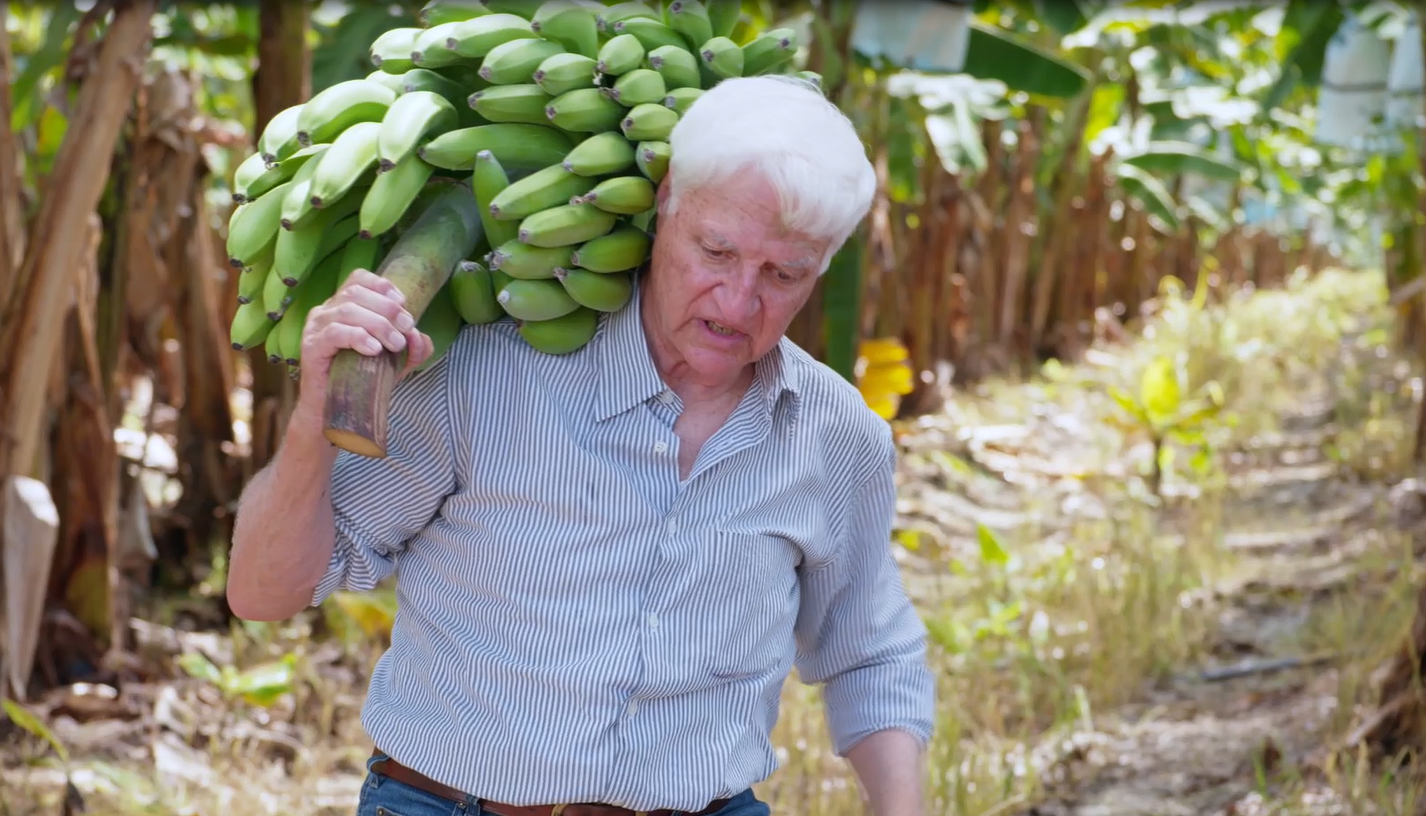
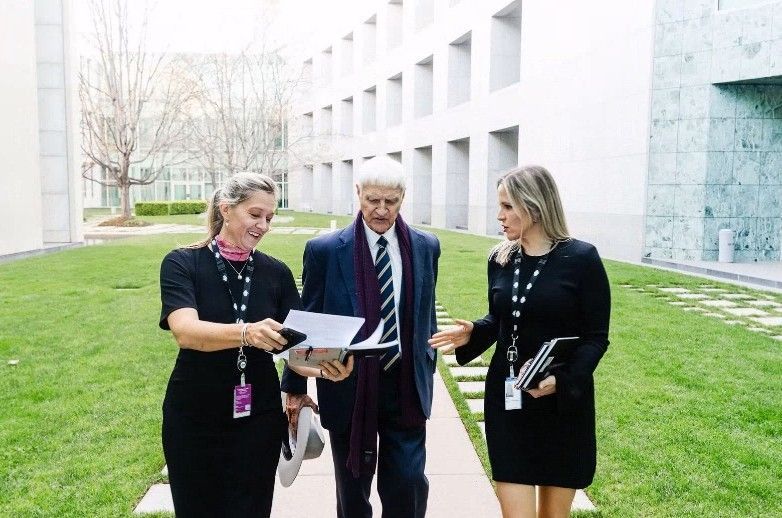
In this instalment of the Gumtree Series Podcast, Bob Katter cuts straight to the heart of the challenges facing Far North Queensland and regional Australia. Episode 4 dives into the looming banana import crisis, exposing the pressures placed on local growers and the broader implications for Australia’s biosecurity and food sovereignty. Bob also takes aim at the lack of accountability within the federal government, questioning how long critical regional industries can withstand policy neglect. From there, the conversation shifts west to Mount Isa, where the uncertain future of the Copper Smelter raises urgent concerns for jobs, economic stability, and the long-term viability of resource communities. Rounding out the episode, Bob champions the need for a Reserve Resource Policy, a framework to ensure Australia retains control over its own natural wealth and secures a fair return for its people. Bold, unapologetic, and grounded in the realities of the bush, Episode 4 is essential listening for anyone who cares about the future of Australia. Hosted by his Chiefs; Kahla Kruger and Elise Nucifora.

By Kahla Kruger
•
November 12, 2025
Yesterday, Hon Bob Katter MP was honoured to attend the commemorative service held by the Herbert River RSL Sub Branch in Ingham. In a moving gathering of veterans, families and community members, Mr Katter said together, they reflected on the service of our Anzacs and all those who have served our nation. "Thank you to everyone who attended the Ingham service with me yesterday in honour of our veterans," Mr Katter said. "Also, a big thank you to the Herbert River RSL Sub Branch in Ingham for organising another wonderful, dignified and respectful event." In recent years, Bob Katter has consistently emphasised the importance of remembering the sacrifices made by our servicemen and women. He has urged that our returned veterans be afforded dignity and fair treatment. “Remembrance Day and ANZAC Day are both timely reminders for veterans, their families and for the general public to acknowledge the sacrifices that Australians have made, and continue to make, for our country. At the Ingham service, Bob Katter reaffirmed his commitment to supporting our veterans and ensuring their sacrifice is never forgotten. He acknowledged the courage of those who have served, the ongoing service of the RSL branches and the vital role of community remembrance. The Office of Bob Katter MP looks forward to continuing to work with local RSL branches and veterans’ organisations across North Queensland to honour our uniformed service – past and present. ENDS
By Kahla Kruger
•
November 9, 2025
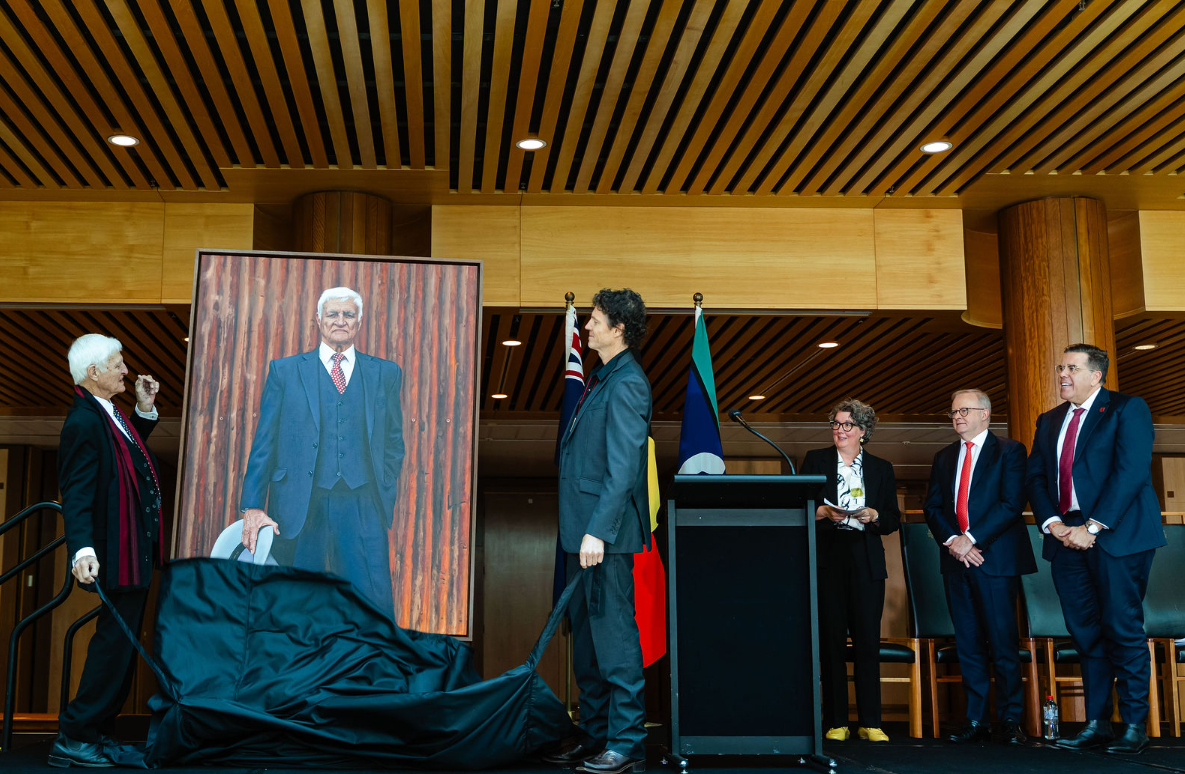
KAP Member for Kennedy, Bob Katter MP, was formally honoured last week with the unveiling of his official portrait in Parliament House in Canberra. The work, painted by renowned Australian artist David Darcy, joins the collection of portraits of former Prime Ministers, Speakers, Governor Generals and a small handful of others who have made a significant contribution to the nation. Mr Katter used the occasion to pay tribute not only to his family and colleagues but to the generations of Australians whose resilience and ingenuity built the country. “This is not a painting of ‘a person’ and I hope nobody sees it that way,” Mr Katter said. “It’s recognition of people that have very strong feelings about this country, to make it a land of opportunity, to have the same wonderful opportunities that I and most of my generation enjoyed.” In his speech, Mr Katter thanked Prime Minister Anthony Albanese, Speaker of the House Milton Dick, and acknowledged his long-standing friendship since entering Parliament with the Prime Minister, as well as the Speaker’s Charters Towers family connection. “I have been good friends with Anthony. Always liked the bloke since we first went into Parliament together. Albo, we’ve had words in the past, but whatever your shortcomings may be, I consider you a good friend,” Mr Katter said. He also recognised the work of Queensland grazier Russell Lethbridge and the Prime Minister in progressing the long-envisioned inland highway linking Far North Queensland to Melbourne. “That great inland highway will be completed within two and a half years, and I want to put on public record, thank you to both Russell Lethbridge and yourself, PM,” he said. Reflecting on his early political influences, Mr Katter paid tribute to both former Prime Minister John Howard and his own mentors, Sir Leo Hielscher, Sir Joh Bjelke-Petersen and Lady Pearl Logan. “I was and still am a great admirer of John Howard… But I appreciate Anthony Albanese – who like John Howard, is just an ordinary Australian,” he said. “With the superstars that I had the honour of working with… Leo and Joe, Queensland became the biggest coal exporting state on earth.” The Kennedy MP also reflected on his deep North Queensland roots, recounting stories of family service and sacrifice through war and hard work. “If you add a kid who was born at the end of the Second World War - a kid that knows his family lost a son at Gallipoli and another at Changi, then you understand what you are looking at in that portrait,” Mr Katter said. He paid special tribute to his wife Susie, describing her as the heart of their family and a driving force in his life. “Susie, who I have been madly in love with for 53 years… She took 12 acres of land that did not have a single tree upon it. It now has 1,200 native trees of all variety upon it. A loving wife. Five wonderful children. The girl was good. Real good.” Mr Katter also honoured the pioneers, pastoralists, and workers who shaped the Kennedy electorate and the nation. “This painting does not represent a bloke called Bob Katter. It represents the Charlie Macdonalds, the Dame Mary Gilmores, the Sir Hudson Fisches, the Ernest Henrys, and the Thiess brothers… It will also remember the Leichhardts, the Burke and Wills, the Gilberts, the Edmund Kennedys and all those great trailblazers that lost their lives exploring what Geoffrey Blainey called ‘A Land Half Won.’” He concluded his address with a heartfelt dedication to his late mother, “Every single act of my life has been an affirmation of my mother… So mum, your contribution to Australia is 33 great little Australians that will carry the banner forward. So, this is for you mum. And for all the other mums that have created our great nation.” ENDS
CONTACT DETAILS
INNISFAIL
P: 07 4061 6066
Visit: 14-20 Rankin Street, Innisfail
Post: PO Box 1638 Innisfail Q 4860
MOUNT ISA
P: 07 4743 3534
Visit: 42 Simpson St, Mount Isa City
Post: PO Box 2130 Mount Isa Q 4825
MAREEBA
P: 07 4092 1632
Visit: 141 Byrnes St, Mareeba
Post: PO Box 2206, Mareeba Q 4825
CANBERRA
(when Parliament is sitting)
P: 02 6277 4978
Post: PO Box 6022, Canberra ACT 2600
Local Call within the electorate
P: 1300 301 942
Email: Bob.Katter.MP@aph.gov.au
