Families pay no tax: Katter’s proposed shake up of income tax for ‘dying’ country

February 13, 2024

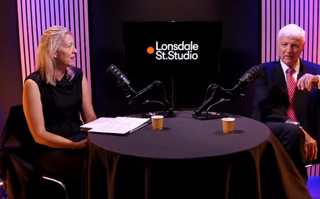
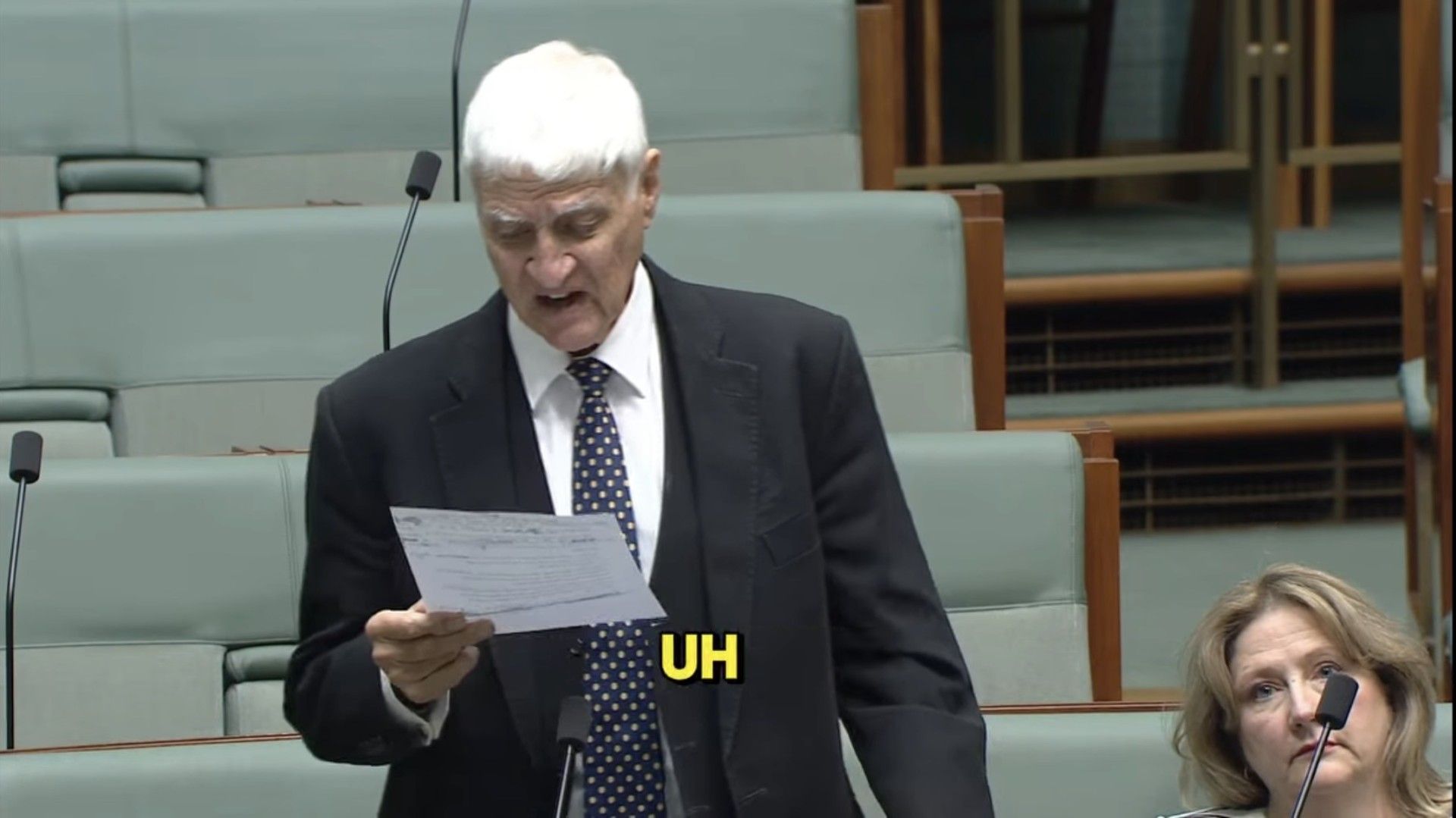
FATHER of the House and Katter’s Australian Party MP Bob Katter says under his “split income” taxation model, families would virtually be exempt from paying income tax.


Mr Katter said Australians were a dying race, as no one could afford to have families and the current tax models we’re favouring dual income, career-minded individuals, rather than someone wanting to raise children.


Mr Katter’s proposal comes as the Federal Government moves on its amended Stage 3 Tax Cuts, being touted as “cost of living relief.” While Mr Katter said he would not stand in the way of any relief including lower taxes, it was far-fetched to claim that about $25 a week from the government’s proposal would help Australian’s struggling with rapidly rising fuel and grocery costs.
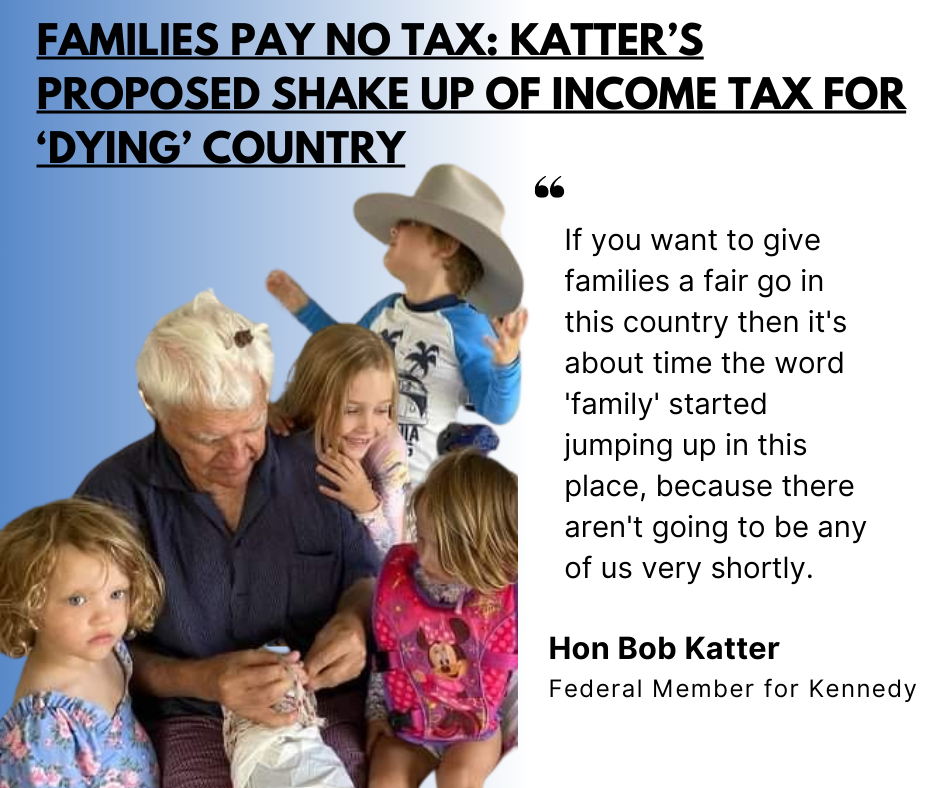
In what would be a complete overhaul of Australia’s income tax model – Mr Katter said his split income proposal would create greater parity between a couple with double income and no kids (DINKS) and a family of four or five.


“The average income being about $100,000, tax on that is $25,000. Each individual in a DINK household is left with $75,000 disposal income.

“Now a family of five. There might be a stay-at-home parent (if they can afford it). So an average income of $100,000 is also $75,000 after tax, however, that’s split five ways – so really each individual has $15,000.


“So where would you rather be? With a disposable income of $75,000 or a disposable income of $15,000?


“So it’s pretty simple, if you’re the sole income earner for a family of five (or however many children), you’re income should be split among your dependants before tax is calculated. That means $100,000 five ways – income $20,000 each – you’re paying virtually no tax.”


Mr Katter said he noted providing extensive cuts to families would impact government revenue, which he said should be countered by a 5 per cent primage charge on all goods being imported into the country.


A recent Australian Bureau of Statistics report stated Australia imported about $500bn worth of goods; a 5 per cent charge on this figure would generate about $25bn in tax revenue. [1]


Further, Mr Katter stated Australia should be earning a greater income from its gas exports.


“When Qatar, which produces and exports the same amount of gas as us, gets $29bn for their gas and we're getting only $600m for ours, surely there is a case. Let's be conservative: surely, we should be getting $15bn. So there's $40 bn that you've got in the till.”


“So if you want to give families a fair go in this country then it's about time the word 'family' started jumping up in this place, because there aren't going to be any of us very shortly.


“I was among the first generation where women were supposed to have careers. Well, they're careering off into nonexistence. A lot of them, very sadly, are old people now. They sit at home, they have no kids to love and no kids to love them, no grandkids to love and no grandkids to love them. It's very sad because society cheated them and lied to them.”


[1] International Trade: Supplementary Information, Financial Year, 2022-23 financial year | Australian Bureau of Statistics (abs.gov.au)
 

By Elise Nucifora July 8, 2026
8 July 2026: North Queensland Member for Kennedy Bob Katter has demanded the Federal Agriculture Minister make public the “deeply concerning” findings of Government investigations into imported peanuts for Australian farmers “who every right to know whether their industry has been exposed to a biosecurity threat”. After meeting with the Federal Minister in Canberra last week, Mr Katter has formally requested in writing the Department of Agriculture’s full transparency on the results of investigations, alongside an immediate halt to peanut imports where Australia's biosecurity cannot be guaranteed. "Australia has strict biosecurity rules for a reason. They exist to stop dangerous pests and diseases getting into this country before they destroy Australian agriculture," said Mr Katter. "However, having been advised by the Minister last week of intensive investigations into imported peanuts – including the germination testing of particular significance – my office has now received evidence confirming germination of the samples collected for laboratory testing… which raises very serious questions because if peanuts can germinate, they are raw.” Mr Katter said the results indicating germination in all peanut varieties tested had raised fears imported peanuts are not undergoing necessary processing to eliminate raw biosecurity threats. "The Australian peanut industry is rightly worried about diseases that simply do not exist here – such as the devastating peanut smut in overseas crops which, once established, slashes yields by up to 75 per cent. Once these diseases are in Australian soil, there’s no magic wand to get rid of them." Mr Katter said reports the imported raw peanuts were being offered for sale nationwide reflected the extent of the potential national biosecurity risk “that we've seen again and again and again... We warned governments not to allow imported prawns because white spot disease would get in. We were ignored, and white spot came in. We warned about citrus canker. We warned about black sigatoka. We warned about papaya fruit fly. We warned about Panama disease. “If you believe governments have the best interest of Australian farmers at heart, then you believe in the tooth fairy – while they continue to gamble with Australia's biosecurity and food security to look after their precious ‘free’ trade agreements.”  Mr Katter said where there was genuine uncertainty about whether imported peanuts complied with Australia's biosecurity requirements, “they should not be coming into this country until that uncertainty is resolved. You don't wait until the disease arrives, before you lock the gate." ENDS
By Kahla Kruger July 1, 2026
KAP Federal Member for Kennedy Bob Katter has welcomed the completion of the sale of Phosphate Hill, celebrating it as a major win for North West Queensland workers, industry and the future of Australian fertiliser production. Mr Katter said the announcement represented the culmination of years of relentless campaigning to keep one of Australia's most strategically important industrial assets operating. "This is wonderful news for North West Queensland," Mr Katter said. "For years we've been bashing the doors down, that if Australia wanted to keep industry alive, governments had to step in and secure a future for assets like Phosphate Hill." Mr Katter said the federal government’s Reserve Resource Policy had been instrumental in helping create the conditions for the sale. "Getting a Reserve Resource Policy in place has been one of the major achievements of my political life. We fought tooth and nail because Australia should never be paying world-leading prices for our own gas. "Our competitors in countries like the United States and Russia have access to affordable energy, while Australian manufacturers have been paying more than $16 a unit for gas.” Mr Katter said affordable gas was fundamental to the survival of the North West's industrial base. "Everything at Phosphate Hill depends on gas. It powers the plant and drives the chemical processes that turn our natural resources into the fertiliser. "Only a year or so ago we were staring down the barrel of losing one of Australia's biggest industrial centres, with the closure of copper and phosphate production threatening thousands of livelihoods across the North West. "This is an enormous relief for the workers, contractors, families and communities who never gave up. "I particularly want to thank the people of North West Queensland who stood together and fought for this outcome. They refused to accept that these jobs should disappear, and today their determination has been rewarded." Mr Katter said the focus must now be on ensuring Phosphate Hill has the affordable energy certainty needed to remain strong operation for decades to come.  -ENDS-
By Kahla Kruger June 25, 2026
Parliament is back and so is the fight for Australia's future. This week, Bob and Elise sit down in Canberra to tackle one of the country's most contentious issues: immigration. Was the Bondi tragedy a warning sign? Bob argues it exposed much deeper problems, and that Australia's political class has abandoned its duty to protect the nation. Plus, inside Bob's $300 billion plan to transform Australia from a country that spends money into one that makes it. Listen now!
By Kahla Kruger June 21, 2026
This week on Wisdom Mongrel Patriot, Bob hits the road and takes listeners deep into the heart of the Kennedy electorate to showcase the people, places and businesses that make Northern Australia tick. Our first stop is the tropical paradise of Mission Beach, where Bob sits down with one of the region's young entrepreneurs, Liam Johnson, owner of Scotties Bar and Grill. Liam shares the reality of starting a small business in today's Australia. Despite the challenges, he's chosen to back himself and invest in his community. Why would a young bloke take the risk? What keeps him going? And what does the future hold for regional small business? Along the way, Bob and Elise explore the wider Mission Beach region; one of Australia's true hidden gems. From pristine beaches and tropical rainforest to tourism, agriculture and local enterprise, they discuss why this corner of North Queensland continues to attract people looking for opportunity and a better way of life. And because no road trip with Bob would be complete without it, listeners are treated to another classic Bob serenade that proves once again that politics and music are never far apart in Kennedy. This week is a story about backing yourself, building something from scratch and having a crack when plenty of others wouldn't.  Pull up a stool, grab a cold one and join Bob as he takes Wisdom Mongrel Patriot on the road. 🎙️🍻🌴
By Kahla Kruger June 4, 2026
This week, Bob sits down with AgForce Queensland President Shane McCarthy, better known to mates and colleagues simply as "Sheep". In a frank discussion about the future of Australian agriculture, Sheep outlines the biggest challenges facing farmers today. He discusses the need for cutting through layers of red and green tape to ensure that producers can get on with the job of feeding the nation. The pair discuss the growing burden of regulation, the need for practical policy solutions, and why governments must start trusting farmers instead of tying them up in bureaucracy. They also tackle the escalating pest crisis affecting rural Australia, including the impact of pigs, wild dogs, wild cats and other feral animals and invasive species that continue to devastate livestock, crops and native ecosystems across the country. Along the way, Bob and Sheep share a few laughs, including a brief detour into the mystery of Bob's famously crooked nose, before reflecting on the homeland and values that shaped them both. It's a conversation about agriculture, common sense and the people who keep Australia fed. Listen now for a paddock-to-parliament discussion on farming, freedom and the future of regional Australia.
texan
By Kahla Kruger June 1, 2026
For decades I've been saying that water is the key to Australia's future. We don't have to wonder what happens when you build the infrastructure to harness it—we've just heard it firsthand from the people who've lived it. A big thank you to Rod Wetsel, Jake Lederle and Quentin Wetsel for travelling all the way from Texas to Hughenden to share their experience. Their lessons from Sweetwater and beyond have shown exactly what happens when governments back irrigation and transmission infrastructure: industries grow, jobs are created, and towns that were once shrinking begin to thrive. We're saving years of trial and error by listening to people who have already walked this path. Congratulations to Mayor Kate Peddle, Flinders Shire Council, RAPAD, the Local Government Association of Queensland and everyone who helped bring this delegation together. These are the conversations that can shape the future of inland Australia.  The answer has never been to abandon the bush. The answer is to build it. That's how you nation-build.
By Kahla Kruger May 28, 2026
28 May 2026: On World Blood Cancer Day today, Kennedy MP Bob Katter has welcomed the Federal Government’s announcement of strengthened funding for a major recruitment campaign to register hundreds of thousands more stem cell donors to be potentially called upon help save the lives of fellow Australians. In response to a question from Mr Katter in Parliament yesterday, the Health Minister confirmed Australia continued to hold one of the smallest stem cell donor registries of all developed countries – three years after vowing to expedite a significant increase in lagging donor registrations following representations by Mr Katter. The Minister also confirmed the Government’s call for tenders this week to establish a specialist stem cell donor registry and clinical service, to facilitate greater donor-recipient matches as the last hope for survivors. Mr Katter said the Life Saving List community campaigners had increased bone marrow donor registrants from 168,000 to 190,000 in the three years since the Health Minister noted Australia had not moved fast enough to help more blood cancer patients find donors. “In these three years, Australia has lost 18,000 lives – 20 people a day – including my nephew Liam,” he told Parliament before today joining community-based campaigners with the Parliamentary Group on Bone Marrow Donation to mark World Cancer Day in the Speaker’s Courtyard, where special guests from the Canberra Raiders demonstrated the quick and simple test to go on the register with just a cheek swab, or when donating blood. Along with Australian Red Cross Lifeblood and Stem Cell Donors Australia, Life Saving List campaigner Josephine O’Brien said she was grateful for the progress in the two years since the premature death of husband Liam, who remained steadfast in his commitment to growing the stem cell donor registry whilst fighting for his own life. Acknowledging the work of Lifeblood for the treatments Liam required daily thanks to the kindness of strangers donating, Mrs O’Brien said: “No family should have to carry the weight of finding a donor alone. When someone you love needs a stem cell match, you are already facing the hardest moment of your life.” She also paid tribute to the Canberra Raiders for their ongoing support with the “relentless efforts” of campaigners and Parliamentary Group on Bone Marrow Donation – including Mr Katter, Macarthur MP Dr Mike Freelander, Kooyong MP Dr Monique Ryan, Forde MP Mr Ted O’Brien, Lyons MP Hon. Rebecca White and their staff – who fought for the inclusion in 2023 of cheek-swab registrations as “a giant leap forward for Australia that would not have been achieved for many years without the force of Liam O’Brien behind it”. Mr Katter said the additional expansion of 17-year-olds to the list of eligible donors would increase the pool of potential registrants from which to recruit potential stem cell donors by several hundred thousand young Australians; and welcomed the Minister’s further advice that the successful tenderer to provide clinical services to match donors with patients, would be asked to consider whether the age limit be raised from 35-40 years.
By Kahla Kruger May 28, 2026
Josephine O'Brien joins Wisdom Mongrel Patriot on World Blood Cancer Day to share the deeply personal story behind the campaign that is transforming Australia's stem cell donor registry. After losing her husband Liam to blood cancer, Josephine has turned unimaginable grief into action, leading the fight to grow Australia's donor register and give other families the chance they never had. Bob Katter, his Chief of Staff Kahla Kruger, and Josephine discuss Australia's chronic shortage of stem cell donors, the progress made through the Life Saving List campaign, the importance of simple cheek-swab registrations, and why thousands more young Australians are needed on the register. This is a story of courage, persistence and hope, and a reminder that a single donor can mean the difference between life and death. Every Australian aged 17-35 can help. One cheek swab could save a life.
By Kahla Kruger May 25, 2026
Australia was once a country where an ordinary Australian could buy a home, raise a family and have the mortgage knocked over by 30. Today, young Australians are being sold a very different dream, a lifetime on the hamster wheel, saddled with million-dollar mortgages they may never escape.
By Kahla Kruger May 13, 2026
In this episode of Wisdom Mongrel Patriot, Bob Katter and Elise deliver a blunt dissection of the 2026 Federal Budget - and ask the question many in the bush are already asking: where exactly does Regional Australia fit into the nation’s future? Where does self-sufficiency fit? Where does the Australia we used to know and love fit?