Halve fuel excise or watch fruit rot, shelves empty
March 17, 2026
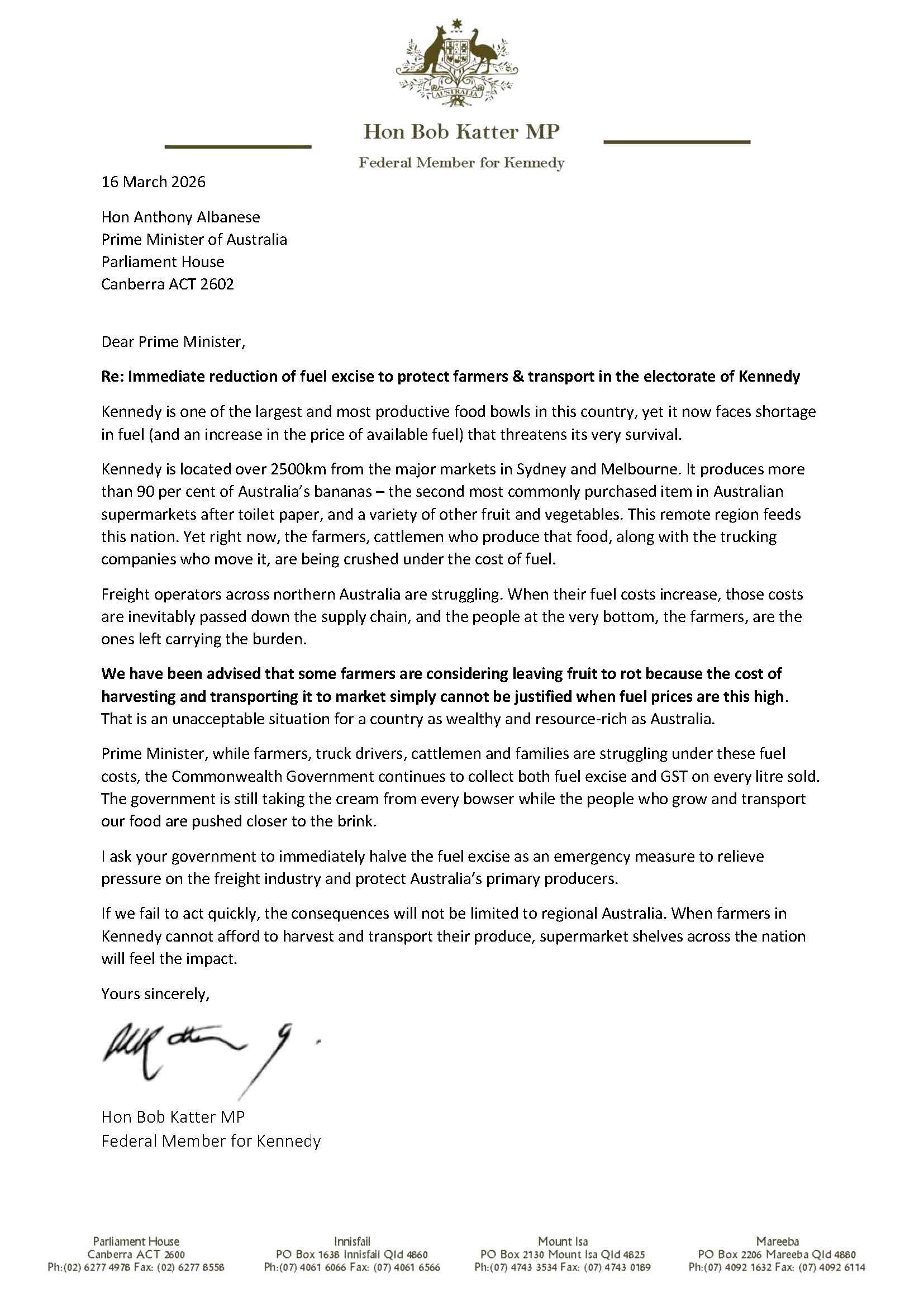
KAP Federal Member for Kennedy Bob Katter has written to the Prime Minister to immediately halve fuel excise to deliver emergency relief from record price pressures crippling the nation’s freight industry, and protect Australia’s primary producers.
Mr Katter has warned the PM that farmers and freight operators being crushed by fuel costs across North Queensland are now reaching breaking point – with the escalating threat to their viability raising alarm that Australia’s biggest banana-growing region faces the prospect of fruit being left to rot this season, due to prohibitive fuel prices for harvest and transport.
“If we fail to act quickly, the consequences will not be limited to regional Australia,” Mr Katter wrote to the PM. “When farmers in Kennedy cannot afford to harvest and transport their produce, supermarket shelves across the nation will feel the impact.”
Mr Katter said that while farmers, truck drivers and families struggled under exorbitant fuel costs, the Commonwealth Government continued to collect both fuel excise and GST on every litre sold – “still taking the cream from every bowser while the people who grow and transport our food are pushed closer to the brink”.
With the North Queensland electorate of Kennedy accounting for one of the nation’s largest and most productive food bowls – growing 90 per cent of Australia’s bananas for our second-most bought supermarket item, after toilet paper – Mr Katter said reports of growers now questioning whether they could afford to harvest fruit this season were “an unacceptable situation for a country as wealthy and resource-rich as Australia”.
“We are being told farmers are letting fruit rot as the cost of picking it and trucking it to market no longer stacks up. That should send a chill through every government office in this country.”
With immense pressure on the road freight industry that underpins agricultural supply chains, major North Queensland operators fear the unsustainable burden of out-of-control fuel costs.
“Companies such as Blenner’s Transport and Curley's Transport – the lifeblood of our supply chain in North Queensland, moving produce from paddocks to plates – they are left with no choice but to pass on those increasing costs down the line,” said Mr Katter. “And the people at the very bottom of that chain are our farmers.”
Mr Katter said halving the fuel excise would deliver relief not just to freight companies and farmers, but also families across the country. “This is a simple decision the Prime Minister can make right now to protect Australia’s farmers and the supply chain that feeds this nation.”
ENDS
Katter hosts public meeting to fight for fair representation
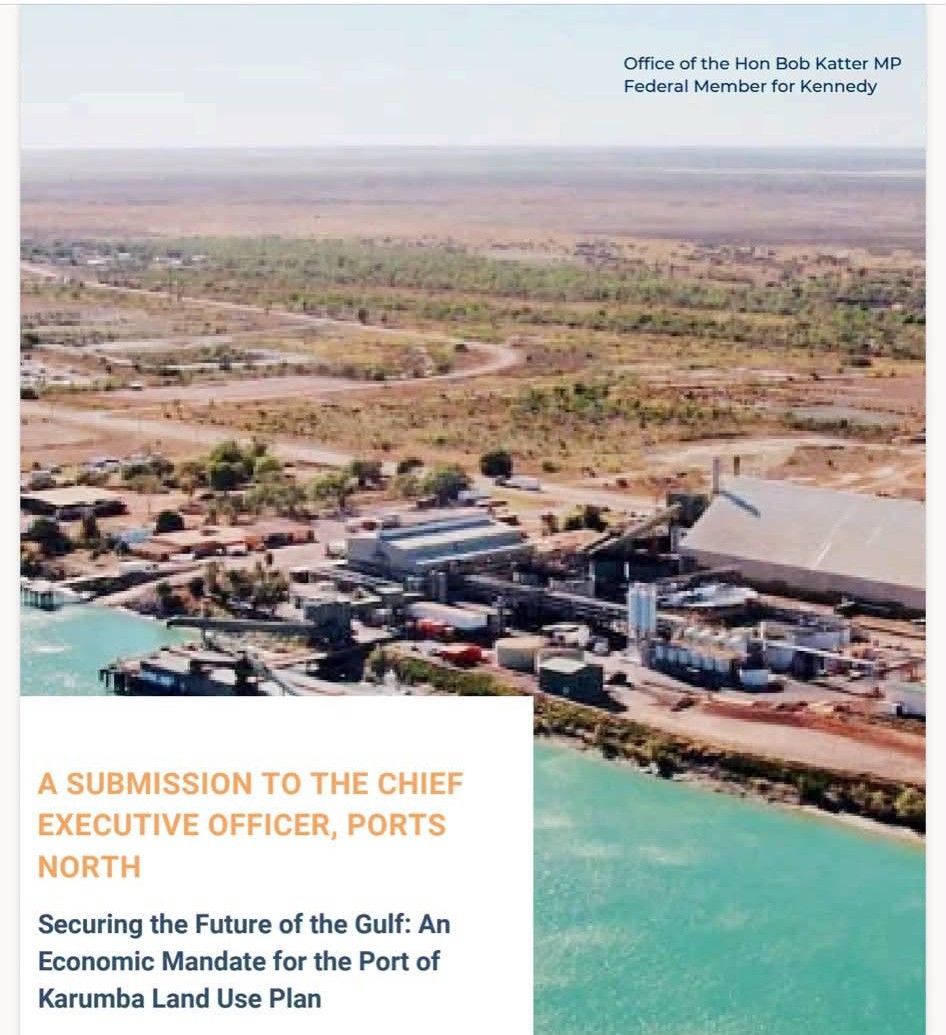
The Port of Karumba serves as the primary maritime gateway for the Gulf of Carpentaria, providing key access between our southern states and the essential Asian markets and beyond. The port is a stones throw from the North West Minerals Province, vast untapped volumes of fresh water, rich soils and our northern regional agricultural sectors. The future of the port must include serious upgrades to the road network that connect it these vital resources and the rest of Australia. This submission advocates for not only broad consideration of port access and users, but also for key Inland road networks to be placed on the National Land Transport Network (NLTN) to unlock long-term, ongoing Federal funding.
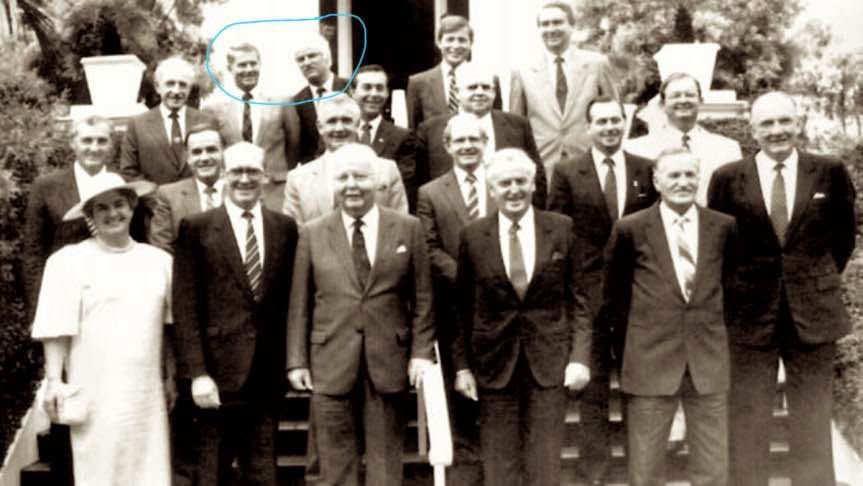
One of my two closest friends in Parliament, Vince Patrick Lester OAM (1939-2026) was the classical underdog in every sense of the word. Brought up by his struggling mother, the bell boy and a baker’s apprentice with no secondary education was the kid born with nothing. Vince was an extraordinary MP consistently delivering for his electorate – whether it be the Great Inland Highway or a local community centre. Every Australian should be inspired by Vince Lester – Always polite, never arrogant. Always fighting for the little people. May God’s blessings be upon Vince – a good bloke. Bob and Vince Lester pictured with the 8th Bjelke-Petersen Cabinet.
This is a subtitle for your new post
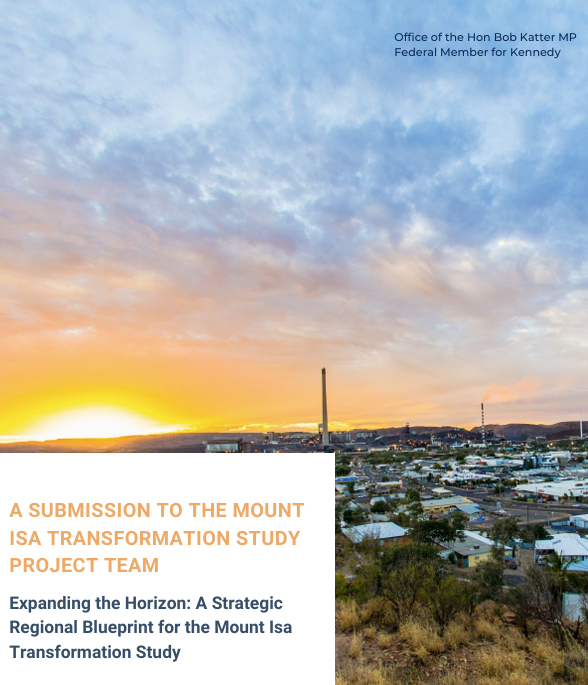
The “Isa” is Australia’s economic future. Surrounded by one of the world’s richest minerals province, rich pastoral lands and within a region of north Australia that has access to nearly half of Australia’s surface water - the ‘Isa’ is destined for big things. However, infrastructure is needed to unlock this vast wealth and opportunity. Bob’s submission to Mount Isa Transformation Study highlights these opportunities and outlines some of the key infrastructure requirements.
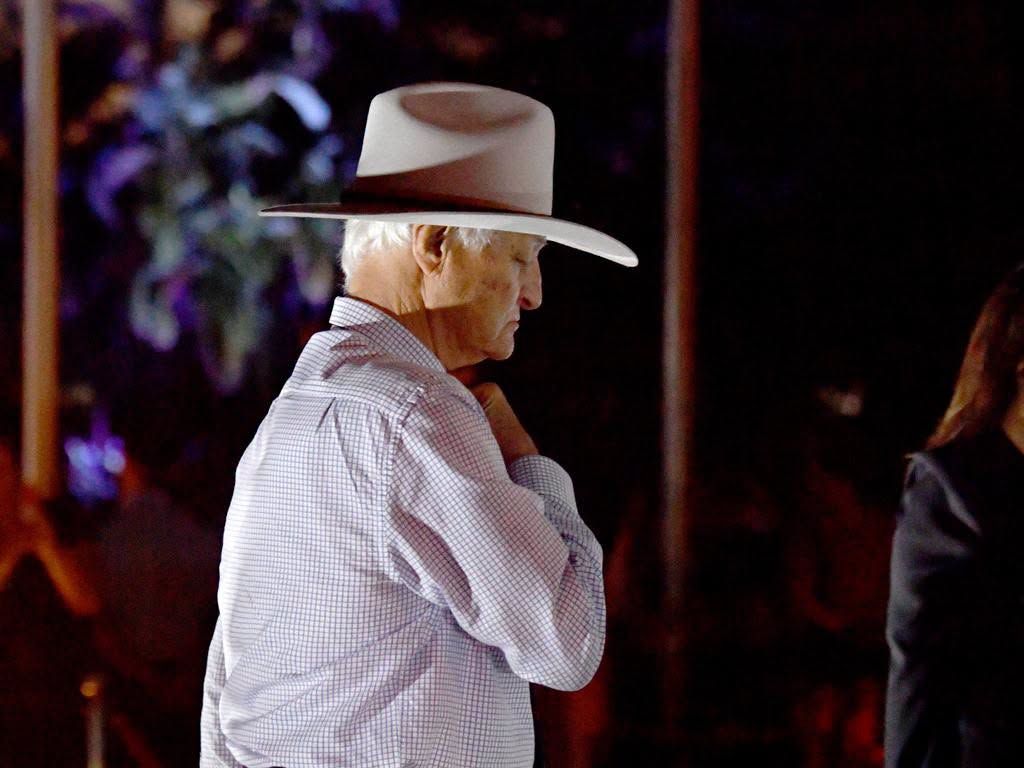
Today we honour the Australians who served during the Vietnam War. We remember those who made the ultimate sacrifice, those who returned home carrying the scars of their service, and the families who stood beside them. For many Vietnam veterans, the recognition and respect they deserved was far too long coming. Today, we say thank you for your service, your courage and your sacrifice. Lest We Forget.

Throughout Australia our Post Offices aren’t just a luxury… for many, they are essential. Often they are the heart, soul and lifeblood of our country towns. A Senate Committee is currently looking at the future of our post offices - we’ve put in a submission highlighting the integral role of our post offices, fighting to ensure they remain open across Australia and continue to provide this vital service. To all the posties out there… thank you for keeping us connected.
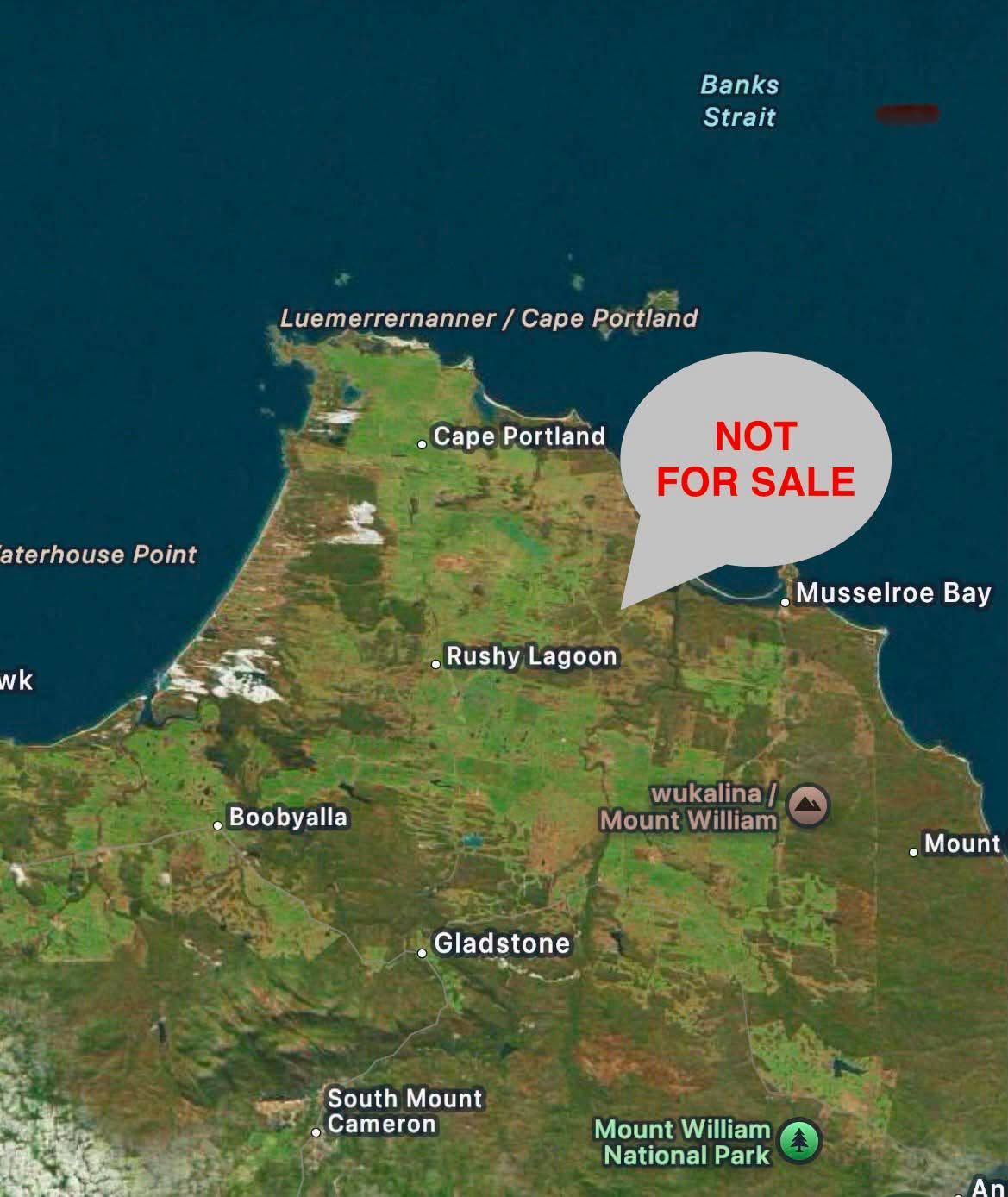
Is government seriously that tone deaf that it would permit the sale of 22,000 hectares of prime agricultural land to foreign investors????? UNFORTUNATELY .. the answer is YES . Our government has allowed the sale of a huge “Rushy Lagoon” property in Tasmania. THIS PROPERTY is roughly one-and-a-half times the size of Washington, D.C. (17,700 ha), and would fit roughly 30,800 international soccer pitches. THIS PROPERTY at capacity runs 85,000 DSE dairy and beef cattle. THIS PROPERTY employs hundreds of locals and supports the entire economy of the towns throughout the region. THIS PROPERTY is key to the sustainability and self-sufficiency of Australia’s domestic beef and milk markets. The INTERNATIONAL PURCHASERS want to turn it all into a “pine farm” - sacking staff and destroying the local economy, but also depriving Australia of the agricultural and wealth generation that comes with such a large agricultural enterprise. Ignoring the pleas from locals, government has rubber stamped the sale. AUSTRALIA WE MUST WAKE UP!!!! WE MUST FIGHT AGAINST FOREIGN LANDLORDS!!!! IT MIGHT NOT BE HAPPENING IN YOUR BACKYARD NOW…. BUT IT WILL BE SOON!!! AUSTRALIA IS NOT… AND SHOULD NEVER BE… FOR SALE!!!!
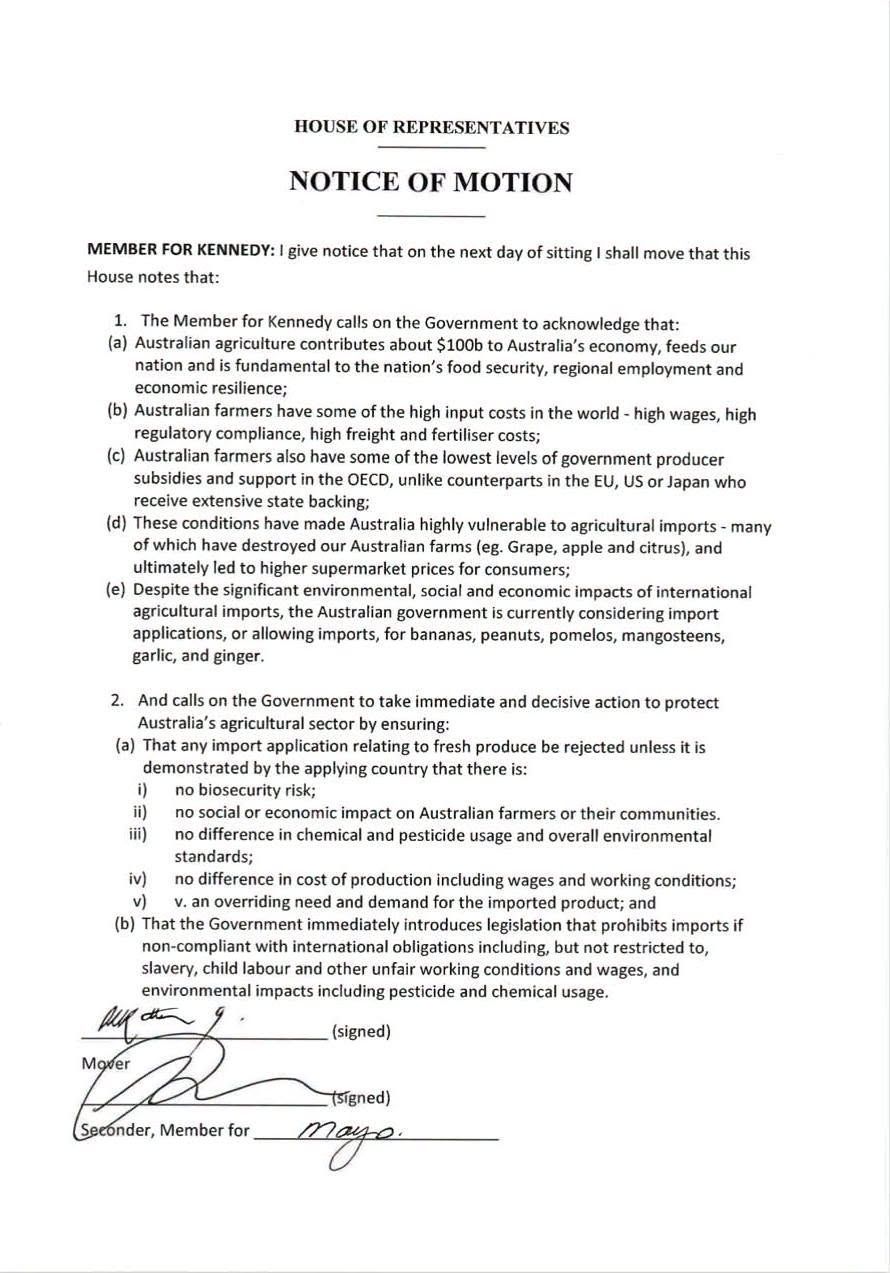
8 July 2026: North Queensland Member for Kennedy Bob Katter has demanded the Federal Agriculture Minister make public the “deeply concerning” findings of Government investigations into imported peanuts for Australian farmers “who every right to know whether their industry has been exposed to a biosecurity threat”. After meeting with the Federal Minister in Canberra last week, Mr Katter has formally requested in writing the Department of Agriculture’s full transparency on the results of investigations, alongside an immediate halt to peanut imports where Australia's biosecurity cannot be guaranteed. "Australia has strict biosecurity rules for a reason. They exist to stop dangerous pests and diseases getting into this country before they destroy Australian agriculture," said Mr Katter. "However, having been advised by the Minister last week of intensive investigations into imported peanuts – including the germination testing of particular significance – my office has now received evidence confirming germination of the samples collected for laboratory testing… which raises very serious questions because if peanuts can germinate, they are raw.” Mr Katter said the results indicating germination in all peanut varieties tested had raised fears imported peanuts are not undergoing necessary processing to eliminate raw biosecurity threats. "The Australian peanut industry is rightly worried about diseases that simply do not exist here – such as the devastating peanut smut in overseas crops which, once established, slashes yields by up to 75 per cent. Once these diseases are in Australian soil, there’s no magic wand to get rid of them." Mr Katter said reports the imported raw peanuts were being offered for sale nationwide reflected the extent of the potential national biosecurity risk “that we've seen again and again and again... We warned governments not to allow imported prawns because white spot disease would get in. We were ignored, and white spot came in. We warned about citrus canker. We warned about black sigatoka. We warned about papaya fruit fly. We warned about Panama disease. “If you believe governments have the best interest of Australian farmers at heart, then you believe in the tooth fairy – while they continue to gamble with Australia's biosecurity and food security to look after their precious ‘free’ trade agreements.” Mr Katter said where there was genuine uncertainty about whether imported peanuts complied with Australia's biosecurity requirements, “they should not be coming into this country until that uncertainty is resolved. You don't wait until the disease arrives, before you lock the gate." ENDS
KAP Federal Member for Kennedy Bob Katter has welcomed the completion of the sale of Phosphate Hill, celebrating it as a major win for North West Queensland workers, industry and the future of Australian fertiliser production. Mr Katter said the announcement represented the culmination of years of relentless campaigning to keep one of Australia's most strategically important industrial assets operating. "This is wonderful news for North West Queensland," Mr Katter said. "For years we've been bashing the doors down, that if Australia wanted to keep industry alive, governments had to step in and secure a future for assets like Phosphate Hill." Mr Katter said the federal government’s Reserve Resource Policy had been instrumental in helping create the conditions for the sale. "Getting a Reserve Resource Policy in place has been one of the major achievements of my political life. We fought tooth and nail because Australia should never be paying world-leading prices for our own gas. "Our competitors in countries like the United States and Russia have access to affordable energy, while Australian manufacturers have been paying more than $16 a unit for gas.” Mr Katter said affordable gas was fundamental to the survival of the North West's industrial base. "Everything at Phosphate Hill depends on gas. It powers the plant and drives the chemical processes that turn our natural resources into the fertiliser. "Only a year or so ago we were staring down the barrel of losing one of Australia's biggest industrial centres, with the closure of copper and phosphate production threatening thousands of livelihoods across the North West. "This is an enormous relief for the workers, contractors, families and communities who never gave up. "I particularly want to thank the people of North West Queensland who stood together and fought for this outcome. They refused to accept that these jobs should disappear, and today their determination has been rewarded." Mr Katter said the focus must now be on ensuring Phosphate Hill has the affordable energy certainty needed to remain strong operation for decades to come. -ENDS-
