Successive governments deserve the cane after 20 years of ethanol ignorance
September 18, 2025
KAP Federal Member for Kennedy, Bob Katter has applauded the Albanese’s $1 billion “Future Made in Australia” biofuels announcement but said that successive former Labor and LNP Governments deserve the “cane” for failing to see the ethanol potential and letting oil companies run rampant around the country.
“Prior to 1992, 98 percent of our fuel requirements were produced in Australia,” Mr Katter said.
“Then Keating got control out from Hawke, and free marketed the Australian economy and it was like taking the steering wheel out of the car. The industry collapsed. Costello was just as much to blame.
“For 20 years, both major parties have spat in the face of ethanol. They’ve ignored the farmers, ignored the mills, ignored the science. Now, with the stroke of a pen, they’ve suddenly found religion in biofuels. Well, it’s better late than never, and we thank them for their efforts here,” Mr Katter said.
In the last parliamentary term, Mr Katter moved his Sovereign Fuel Security Bill, which would see Australia aim to become approximately 80 percent self-sufficient in fuel, reducing dependence on imports. He warned that without serious action, Australia’s fuel supply is vulnerable, fuel and fertiliser costs will remain crushing for farmers, and Australia’s industrial and regional communities will suffer.
“Farmers are paying 100 percent increases on two major cost input items, fuel and fertiliser. Electricity has also gone up 300 percent.
“You just can’t keep farming under these conditions; we must bring down fuel and fertiliser costs if farmers are to survive.
"Ten hectares of sugar cane produces over 10,000 litres of ethanol, and for every hectare of cane planted, 72 ton of carbon dioxide is pulled from the atmosphere. This stuff is pure magic. We can replace imported oil with home-grown fuel, cut emissions, and build up regional economies all at once.
“We need an enforceable ethanol mandate, not another round of studies and subsidies that vanish after the election. Every other major country on earth, including Brazil and the United States, mandate ethanol. So why are we the last?
“We need ethanol, and we need it now. But we need to make sure we don’t see a repeat of the ethanol mandate in Queensland where none of the oil companies that owned the petrol stations provided the infrastructure needed to offer ethanol. It should be legislated that these service stations will need be retrofitted to have ethanol capability as part of any biofuel industry.”
Mr Katter warned that Australia’s fuel storage supplies have diminished over the years which puts Australia at a national security risk, further demonstrating a sovereign fuel security necessity.
“The Government has said we have 30 days fuel supply, but I don’t even think it will last three days if there’s a situation where our fuel trade pathways are cut off. We must have supply of electricity and fuel if we are to survive as a country.”
“When the NRMA blew the whistle on this extraordinary situation, Angus Taylor under direction of his cabinet, put our fuel supplies in Texas, USA. I mean, how utterly absurd! That shows you the level of competence in our governments.”
ENDS
https://www.theaustralian.com.au/nation/labor-earmarks-11bn-for-future-made-in-australia-biofuels-industry/news-story/e24cf62bada7edf93fe5c32c57db1837
https://www.bobkatter.com.au/govts-inaction-on-fuel-security-leaves-australia-vulnerable
https://www.abc.net.au/news/2020-04-22/government-to-buy-fuel-secure-national-stockpile/12173276
8 September 2026: A bold plan to reverse the plunging birthrate by recognising the value of unpaid care has been rejected by Government in favour of incentivising more working parents of our “vanishing race”, warns the Father of the House of Representatives and North Queensland MP of half-a-century, Bob Katter. In addition to asking for a $75,000 payment per birth, the Federal Member for Kennedy this week asked the Treasurer in Question Time to help families crippled by the cost-of-living crisis with taxable income-splitting to boost disposable incomes for spouses raising children on a single wage by about 10 per cent on average. But instead of acknowledging annual tax relief of about $8000-$10,000 for struggling families with a single wage-earner on $80,000-$150,000 a year – which would boost household budgets between 9-12 per cent 1 – the Treasurer claimed income-splitting would “disincentivise” women’s workforce participation, leaving them “economically dependent” on men, and “cost the budget substantially” to deliver the “lion’s share” of benefits to “higher wealth” families whilst “denying” those in lower tax bands. Mr Katter accused the Treasurer of “throwing the baby out with the bathwater” by dismissing outright the long-overdue “fairer family tax” policy with the introduction of a $75,000 payment for all new mothers “to spend as they see fit – from putting food on the table to investing in superannuation for their future”. “Families cannot make ends meet,” Mr Katter told the Treasurer in reference to average household debt at over $300,000 or $400,000 for under-50s, with the hyper-inflated cost-of-living now crippling 25 per cent of parent couples on a single income who suffered the “appalling inequality at tax time” that leaves a stay-at-home mum and three kids struggling by on $15,000 per person, whilst double-income-no-kids (DINKS) enjoy disposable incomes of $75,000 each. “Surely, family income-splitting makes taxation fairer, whilst a $75,000 birthing payment would help arrest Australia's plunging birthrates,” he pleaded in the Parliament. Mr Katter said the Treasurer’s devaluing of unpaid work further betrayed all parents “who bear enormous responsibility for raising our nation’s future generations to advance Australia fair”. “The Treasurer’s righteous virtue-signalling this week in the Parliament – supposedly on the side of women who quite reasonably want to be paid for their work – in turn infantilises mothers whose endless work for their family remains unpaid, like many carers, when the choice either way should be in women’s hands,” said Mr Katter. “Instead, Australian mums and dads are financially penalised when only one parent is paying income tax – which is really the only productivity measure that the Treasurer truly cares about. “But while he’s crying poor on an estimated $3 billion annual cost of income-splitting to the budget bottom line, he’s spending five times that subsidising the private childcare industry to boast about the benefits for women in the Kennedy electorate who can be on endless waitlists or have zero local early childhood places. “And when you tally the cost to taxpayers of about $14 billion propping up commercial childcare plus another $5 billion a year in parental leave – not to mention an estimated $20 billion in means-tested Family Tax Benefits – it puts into perspective the estimated $22 billion cost of an upfront $75,000 bonus for fewer than 300,000 births a year, to help lift Australia back up to relative post-war boomer rates.” Projections of the compounding benefits of lifting birthrates from below 1.5 to above the 2.1 replacement rate, align with an Australian population reaching 80 million with one million births annually in a century 2 . “I want 80 million people in this country so our industries can operate on economies of scale; so we’re not doomed to repeat the history of ‘a people without land seeking for a land without people’,” said Mr Katter. ENDS
Katter hosts public meeting to fight for fair representation
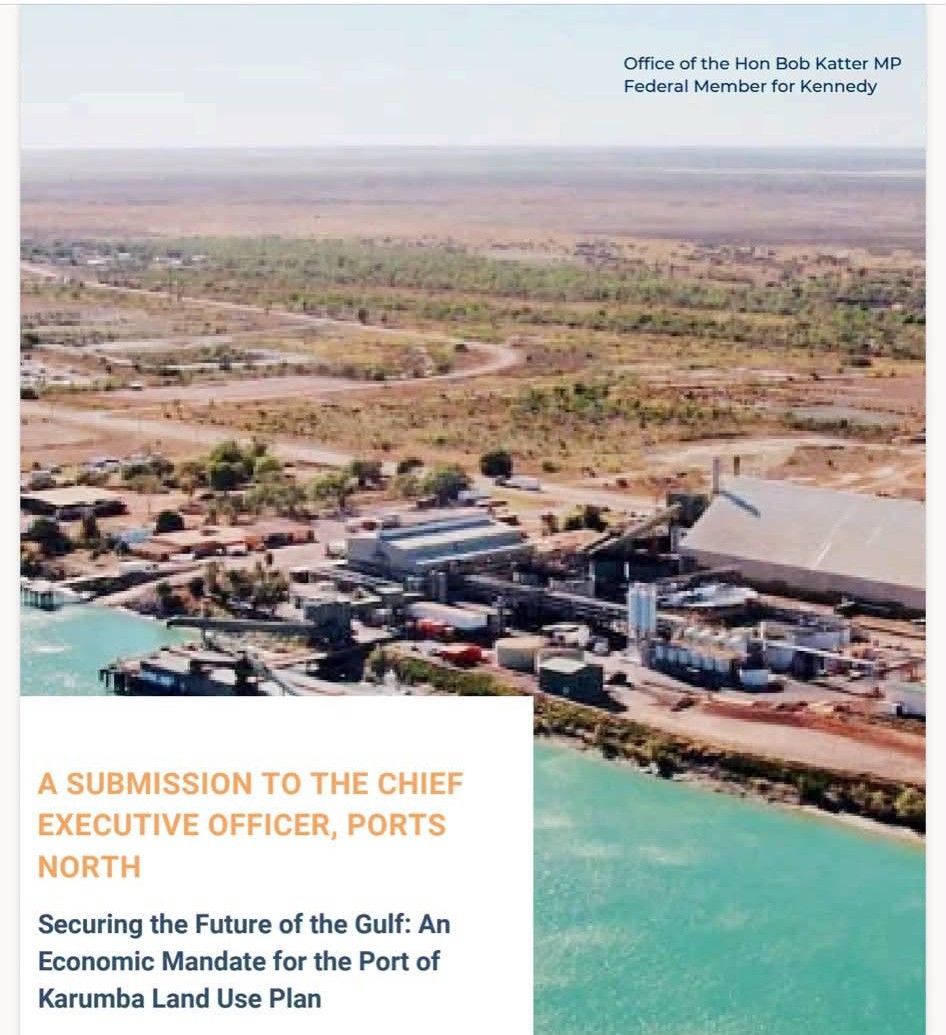
The Port of Karumba serves as the primary maritime gateway for the Gulf of Carpentaria, providing key access between our southern states and the essential Asian markets and beyond. The port is a stones throw from the North West Minerals Province, vast untapped volumes of fresh water, rich soils and our northern regional agricultural sectors. The future of the port must include serious upgrades to the road network that connect it these vital resources and the rest of Australia. This submission advocates for not only broad consideration of port access and users, but also for key Inland road networks to be placed on the National Land Transport Network (NLTN) to unlock long-term, ongoing Federal funding.
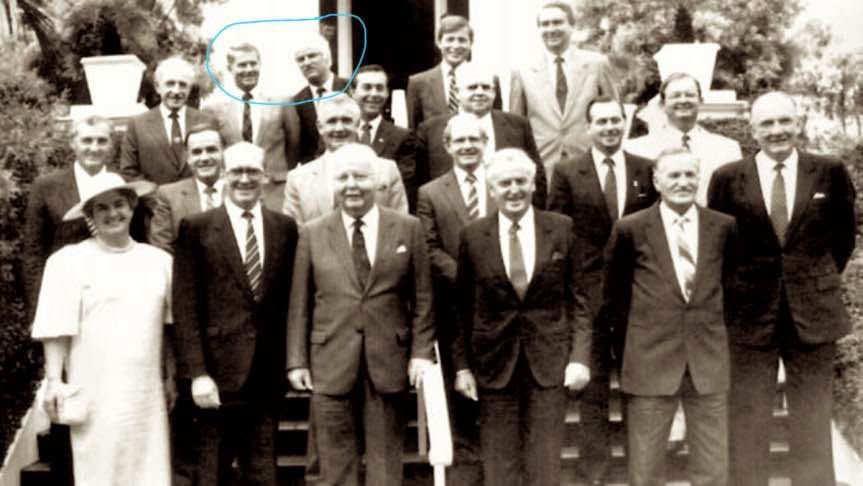
One of my two closest friends in Parliament, Vince Patrick Lester OAM (1939-2026) was the classical underdog in every sense of the word. Brought up by his struggling mother, the bell boy and a baker’s apprentice with no secondary education was the kid born with nothing. Vince was an extraordinary MP consistently delivering for his electorate – whether it be the Great Inland Highway or a local community centre. Every Australian should be inspired by Vince Lester – Always polite, never arrogant. Always fighting for the little people. May God’s blessings be upon Vince – a good bloke. Bob and Vince Lester pictured with the 8th Bjelke-Petersen Cabinet.
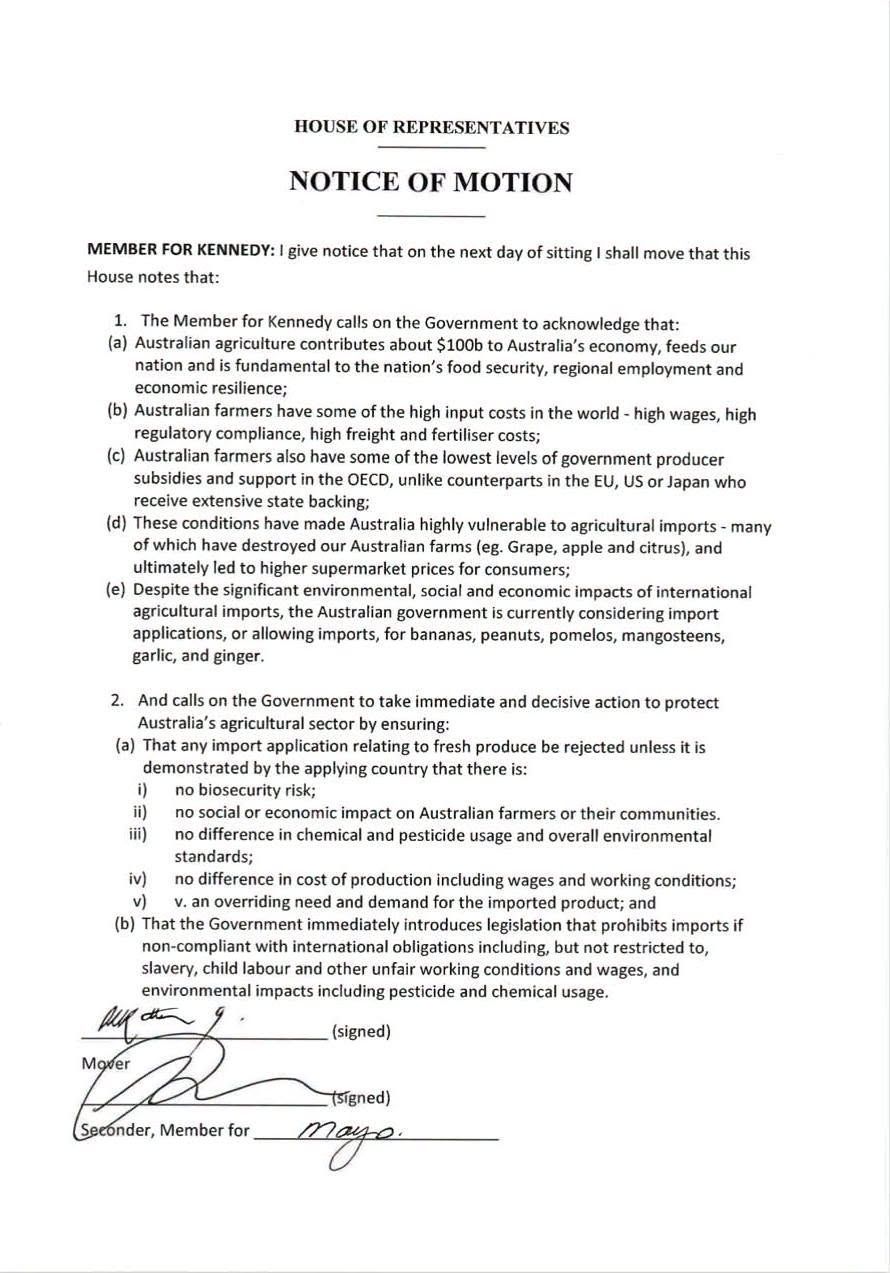
Yesterday I tabled in Parliament a motion that highlights the huge value of Australian agriculture and calls on government to protect it from imports. The treat is real… we have countries that a desperate to get into the Australian market with product that will decimate Australian farming communities and lead to high supermarket prices in the long-term. We must force the Australian government to better protect our fresh produce.
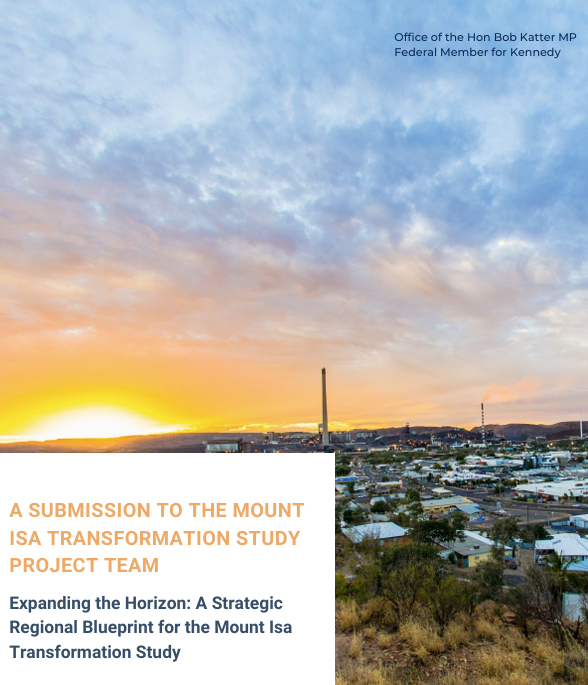
The “Isa” is Australia’s economic future. Surrounded by one of the world’s richest minerals province, rich pastoral lands and within a region of north Australia that has access to nearly half of Australia’s surface water - the ‘Isa’ is destined for big things. However, infrastructure is needed to unlock this vast wealth and opportunity. Bob’s submission to Mount Isa Transformation Study highlights these opportunities and outlines some of the key infrastructure requirements.
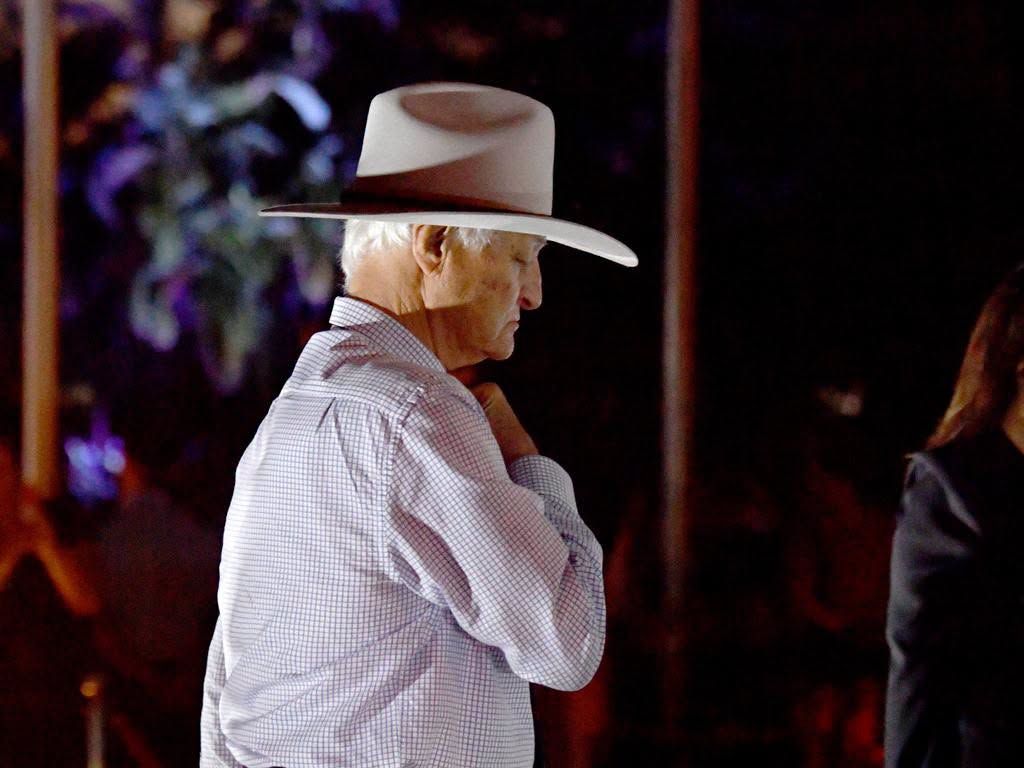
Today we honour the Australians who served during the Vietnam War. We remember those who made the ultimate sacrifice, those who returned home carrying the scars of their service, and the families who stood beside them. For many Vietnam veterans, the recognition and respect they deserved was far too long coming. Today, we say thank you for your service, your courage and your sacrifice. Lest We Forget.

Throughout Australia our Post Offices aren’t just a luxury… for many, they are essential. Often they are the heart, soul and lifeblood of our country towns. A Senate Committee is currently looking at the future of our post offices - we’ve put in a submission highlighting the integral role of our post offices, fighting to ensure they remain open across Australia and continue to provide this vital service. To all the posties out there… thank you for keeping us connected.
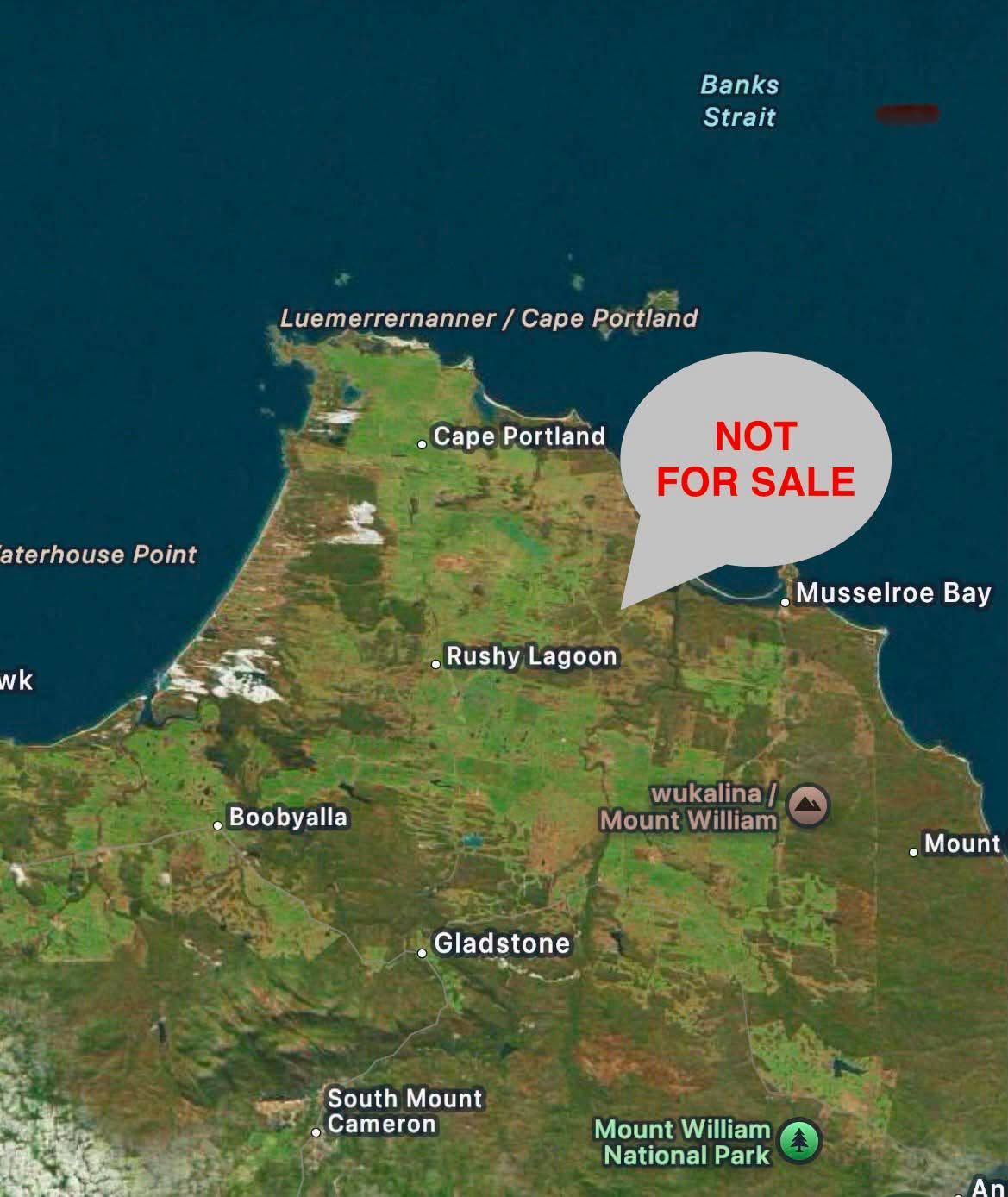
Is government seriously that tone deaf that it would permit the sale of 22,000 hectares of prime agricultural land to foreign investors????? UNFORTUNATELY .. the answer is YES . Our government has allowed the sale of a huge “Rushy Lagoon” property in Tasmania. THIS PROPERTY is roughly one-and-a-half times the size of Washington, D.C. (17,700 ha), and would fit roughly 30,800 international soccer pitches. THIS PROPERTY at capacity runs 85,000 DSE dairy and beef cattle. THIS PROPERTY employs hundreds of locals and supports the entire economy of the towns throughout the region. THIS PROPERTY is key to the sustainability and self-sufficiency of Australia’s domestic beef and milk markets. The INTERNATIONAL PURCHASERS want to turn it all into a “pine farm” - sacking staff and destroying the local economy, but also depriving Australia of the agricultural and wealth generation that comes with such a large agricultural enterprise. Ignoring the pleas from locals, government has rubber stamped the sale. AUSTRALIA WE MUST WAKE UP!!!! WE MUST FIGHT AGAINST FOREIGN LANDLORDS!!!! IT MIGHT NOT BE HAPPENING IN YOUR BACKYARD NOW…. BUT IT WILL BE SOON!!! AUSTRALIA IS NOT… AND SHOULD NEVER BE… FOR SALE!!!!
8 July 2026: North Queensland Member for Kennedy Bob Katter has demanded the Federal Agriculture Minister make public the “deeply concerning” findings of Government investigations into imported peanuts for Australian farmers “who every right to know whether their industry has been exposed to a biosecurity threat”. After meeting with the Federal Minister in Canberra last week, Mr Katter has formally requested in writing the Department of Agriculture’s full transparency on the results of investigations, alongside an immediate halt to peanut imports where Australia's biosecurity cannot be guaranteed. "Australia has strict biosecurity rules for a reason. They exist to stop dangerous pests and diseases getting into this country before they destroy Australian agriculture," said Mr Katter. "However, having been advised by the Minister last week of intensive investigations into imported peanuts – including the germination testing of particular significance – my office has now received evidence confirming germination of the samples collected for laboratory testing… which raises very serious questions because if peanuts can germinate, they are raw.” Mr Katter said the results indicating germination in all peanut varieties tested had raised fears imported peanuts are not undergoing necessary processing to eliminate raw biosecurity threats. "The Australian peanut industry is rightly worried about diseases that simply do not exist here – such as the devastating peanut smut in overseas crops which, once established, slashes yields by up to 75 per cent. Once these diseases are in Australian soil, there’s no magic wand to get rid of them." Mr Katter said reports the imported raw peanuts were being offered for sale nationwide reflected the extent of the potential national biosecurity risk “that we've seen again and again and again... We warned governments not to allow imported prawns because white spot disease would get in. We were ignored, and white spot came in. We warned about citrus canker. We warned about black sigatoka. We warned about papaya fruit fly. We warned about Panama disease. “If you believe governments have the best interest of Australian farmers at heart, then you believe in the tooth fairy – while they continue to gamble with Australia's biosecurity and food security to look after their precious ‘free’ trade agreements.” Mr Katter said where there was genuine uncertainty about whether imported peanuts complied with Australia's biosecurity requirements, “they should not be coming into this country until that uncertainty is resolved. You don't wait until the disease arrives, before you lock the gate." ENDS
